Table of Contents

Who the Blog is For: If you keep searching back pain worse in the morning and getting the same generic mattress tips, this blog is written for you. You wake up stiff, brace for the first few steps, maybe lean on a hot shower to loosen up — then feel almost normal by mid-morning, only to tighten again after sitting a while. It’s for people across Draper and the south end of the Salt Lake Valley who’ve noticed the pattern is tied to the clock, not to anything they did the day before.
Waking up sore before the day has even begun takes a quiet toll — one that’s hard to explain to anyone who hasn’t felt it. You haven’t lifted anything or overdone it, yet there it is every morning: stiffness in your lower back before your feet even touch the floor. After enough mornings like that, it’s natural to stop asking why and just brace for it — to decide this is simply what your body does now, or to blame the mattress and move on. No one would fault you for that. But rest should leave you feeling better than it found you, not stiff and guarded. When the ache is reliably worst first thing and eases as you move, that timing isn’t random — it’s a clue worth reading, not a discomfort to push through.
Key Insights
- Back pain worse in the morning usually points to how you rested, not just how long you slept.
- The night itself isn’t the cause — it’s how an unbalanced frame rests and reloads for hours at a time.
- Stiffness that eases within minutes of moving behaves differently from stiffness that lingers; the difference matters.
- The alignment of your upper neck is a structural contributor to how evenly your whole frame settles at rest.
- Upper cervical care in Draper UT works alongside your physician’s care, never in place of it.
Why Is Your Back Pain Worse in the Morning?
Quick Answer: Back pain that peaks in the morning usually reflects how your body rested overnight, not the night itself. Your physician examines for causes like disc-related changes, inflammatory conditions, and mattress or position factors. How you slept is the spark. A commonly overlooked contributor is structural: how evenly an unbalanced frame can settle while you lie still for hours.
When your back pain is worse in the morning, the obvious suspect is the night — the mattress, the pillow, the way you slept. Those play a part, but they rarely explain the whole pattern, especially the part where it eases once you’re up and moving.
Your physician examines for the causes worth ruling in or out: disc-related changes that feel different after hours of stillness, inflammatory conditions that tend to be worse in the morning, and the plain mechanics of your mattress and sleeping position. That medical look matters, and it’s the right first step.
What a standard look doesn’t usually cover is how evenly your frame rests in the first place. Morning back stiffness is often less about the hours asleep and more about the position your body holds during them — and whether it can settle into a neutral, balanced rest or spends the night under quiet, uneven tension. That’s where the overlooked structural contributor comes in, and it starts higher up than the sore spot.
When to see a doctor first: Back pain with new numbness in the groin or inner thighs, loss of bladder or bowel control, or progressive weakness in the legs needs urgent medical care — don’t wait. And if morning stiffness lasts well beyond an hour, wakes you in the second half of the night, or started before age 40, ask your physician about inflammatory back pain, which needs a medical diagnosis.
What’s Actually Happening While You Sleep
Lying down should be the most restful thing you do all day, and for a balanced frame it is. But if the top of your spine carries a small misalignment, the muscles and joints below it don’t fully switch off at rest — they hold a low, steady tension to keep everything aligned, hour after hour. You don’t feel it while you’re asleep. You feel it in the first few minutes after you wake, before movement flushes it out.
This is also where back pain and sleeping position genuinely matters: a position that’s fine for a balanced frame can concentrate that uneven tension for one that isn’t. It’s not that your mattress is to blame — it’s that the same mattress asks more of a frame that’s already compensating. None of this is about years adding up; it’s about how your body is loaded right now, every single night.
Where Alignment Fits Into the Picture
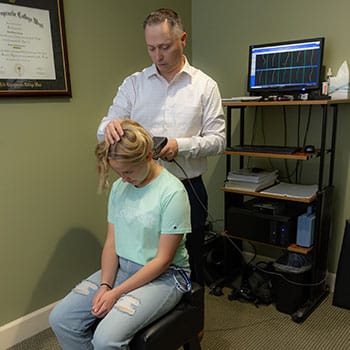
As an upper cervical chiropractor in Draper UT, Dr. Cheney looks specifically at the alignment at the top of the neck and how it shapes the way your whole frame balances and rests. At Source Chiropractic and Wellness, he uses the Knee Chest method — a gentle, imaging-guided, side-specific approach that maps your individual anatomy before any low-force correction. There’s no forceful twisting.
The goal isn’t to chase the morning back stiffness itself but to help your frame settle more evenly, so rest is actually restful. Many people find that upper cervical care in Draper UT fits alongside the medical care they already trust — adding to it, never replacing any part of it.
Start With What Your Mornings Are Telling You
If your back is reliably at its worst first thing and you’ve already looked at the mattress and the pillow, the next useful step may be to look at how your frame rests in the first place. Exploring upper cervical care gives your body a chance to settle more evenly at night — and looking at an upper-neck imbalance sooner may keep it from quietly shaping other patterns down the line. At Source Chiropractic and Wellness in Draper, Dr. John Cheney offers a gentle evaluation to see whether your alignment is part of the picture. When you’re ready, schedule a consultation to take the next step.
Click here to request a consultation with a chiropractor in Draper, UT.
Frequently Asked Questions
Why is my back pain worse in the morning?
Morning pain usually reflects how your body rested, not just how long. Your physician examines for causes like disc-related changes, inflammatory conditions, and mattress or position factors. Beyond those, how evenly your frame settles overnight plays a role — and that’s shaped in part by the alignment at the top of your neck, which is worth evaluating alongside the medical picture.
Is stiffness every morning a sign of something serious?
Usually it’s mechanical and eases with movement, but a few patterns deserve a medical look: stiffness that lasts well over an hour, wakes you in the night, or comes with numbness, leg weakness, or bladder or bowel changes. Those point to causes a physician should evaluate directly. When in doubt, get it checked.
Can my mattress or sleeping position be the whole problem?
They matter, but they’re rarely the whole story. Back pain and sleeping position interact more than either acts alone — the same setup that suits a balanced frame can strain one that’s already compensating. If a new mattress and better sleep posture helped only a little, that’s a clue the position isn’t the root, and something structural may be shaping how you rest.
Why does the stiffness ease once I get moving?
Movement increases circulation and gently reloads your joints and muscles evenly, which clears the low, uneven tension that built up while you were still. That’s why the first few minutes are the worst and things loosen by mid-morning. It’s also why easing-with-movement is a useful signal — it tends to point toward a mechanical or structural pattern rather than a purely inflammatory one.
What’s the difference between inflammatory back pain and mechanical back pain?
Mechanical pain generally eases with movement and worsens with load or certain positions. The inflammatory kind tends to be worst after rest, improves with activity, can wake you in the second half of the night, and often starts before age 40. The distinction guides who evaluates it and how, which is why it’s worth raising with your physician if your mornings fit the second pattern.
Can my neck have anything to do with lower-back stiffness in the morning?
It can contribute. The alignment at the top of your neck influences how your whole frame balances, and that balance shapes how evenly everything rests overnight. An imbalance up top can mean the lower back settles under uneven tension for hours — alongside, not instead of, the causes your physician evaluates.
Does upper cervical care replace seeing my doctor about morning back pain?
No. It works alongside your physician’s care. Your doctor examines for and manages the medical side — disc-related changes, inflammatory conditions, and more; upper cervical care simply looks at a structural contributor many workups don’t focus on: how evenly your frame rests and reloads.
Is upper cervical care gentle enough if my mornings are already painful?
The Knee Chest approach uses gentle, low-force corrections guided by imaging rather than forceful twisting, and an evaluation always comes first to see whether you’re a good candidate. If you’re looking for an upper cervical chiropractor in Draper UT, that evaluation is the place to start.
To schedule a complimentary consultation with Dr. Cheney, call our Draper office at 385-331-7035. You can also click one of the buttons below.
For English Consultation:
Para Consulta en Español:
About the Author