Table of Contents

Who This Blog Is For: If you get vertigo when you roll over or stand up, and you’ve started bracing for it before you even move, this blog is written for you. You’ve probably had the positioning maneuver done, seen your doctor, learned to sit up slowly, maybe even started sleeping propped to avoid setting it off. It’s for people across Draper and the south end of the Salt Lake Valley who’ve done the sensible things and still feel the floor tilt when they change position.
There’s a specific kind of unsteadiness that comes from not trusting your own balance. You hesitate before standing, turn your head carefully, stay half-braced for the room to move even on good days. When the spinning keeps returning after you thought you’d handled it, the frustration isn’t only physical — it’s the quiet worry that no one has found the reason, and that you’re managing this instead of understanding it. When positional vertigo keeps circling back, it often means one part of the picture hasn’t been looked at yet.
Key Insights
- Vertigo when you roll over or stand up usually points to a trigger, not the whole cause.
- Positional movements — rolling over, or the dizziness when standing up — are the spark for an episode, not the reason it keeps returning.
- Your balance system leans on steady signals from the upper neck; when those are inconsistent, recovery can be shakier.
- The alignment of your upper neck is a structural contributor to steadier balance, worth checking.
- Upper cervical care in Draper UT works alongside your physician’s or ENT’s care, never in place of it.
Why Do You Get Vertigo When You Roll Over or Stand Up?
Quick Answer: Positional vertigo usually traces to how your balance system reads movement. Your physician evaluates recognized causes like BPPV, inner-ear conditions such as Meniere’s or labyrinthitis, vestibular migraine, and cervicogenic dizziness from the neck. Rolling over or standing up is the spark that sets off an episode. A commonly overlooked contributor is structural: the alignment of your upper neck.
When the room spins as you roll over or stand up, the movement feels like the cause — but it’s really the trigger. The deeper question is why your balance system is so easily set off.
Your physician looks first at the recognized causes. The most common is BPPV, where tiny crystals in the inner ear shift and send false motion signals; a positioning maneuver like the Epley often helps, and that’s worth doing. Other causes your doctor evaluates include inner-ear conditions like Meniere’s or labyrinthitis, vestibular migraine, and cervicogenic dizziness from the neck.
Positional changes — rolling over in bed, standing up from a chair, tipping your head back at the sink — are the spark. They set off an episode; they don’t explain why the system stays so sensitive between them. The overlooked contributor to that sensitivity is structural, and it starts at the top of the neck.
When to seek medical care first: If dizziness comes on with a sudden severe headache, double vision, slurred speech, weakness, numbness, or trouble walking, seek medical care right away.
Why Chasing Each Episode Isn’t Enough
A positioning maneuver can settle a flare-up, and vestibular exercises help the balance system adapt — many people benefit from both, and neither is something to abandon. But calming each episode isn’t the same as steadying the system that keeps producing them. That’s the difference between a reset and stability: a reset addresses the moment; stability addresses how readily the next one comes. When episodes keep returning, the underlying steadiness is what needs attention.
Where the Upper Neck Comes In
Your sense of balance depends on three streams of information: your inner ear, your eyes, and the position sense from your body — especially the upper neck, dense with sensors that tell your brain where your head is. When those streams agree, you feel steady. When one sends inconsistent signals, you feel the mismatch as unsteadiness or spinning.
This is where neck alignment and vertigo intersect. If the top of the neck sits slightly off, the position signals it sends can be less consistent, so your balance system has noisier input and a harder time settling after a positional change. It’s also part of why people wonder, can neck problems cause dizziness — because the neck is one of the balance system’s main information sources. None of this makes the neck a cause of vertigo; it’s one structural contributor to how steadily the whole system runs.
What Upper Cervical Care in Draper UT Looks At
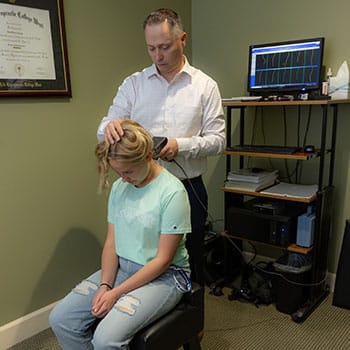
As an upper cervical chiropractor in Draper UT, Dr. Cheney focuses narrowly on the alignment at the very top of the neck and how it feeds your balance and posture. At Source Chiropractic and Wellness, Dr. Cheney uses a gentle, imaging-guided, side-specific approach that maps your individual anatomy before any low-force correction. There’s no forceful twisting of the neck.
The aim isn’t to chase the spinning itself but to give your balance system cleaner, steadier input. Many people find that upper cervical care in Draper UT fits alongside the medical care they already trust — adding to it, never replacing any part of it.
Give Your Balance a Steadier Starting Point
If the room keeps spinning when you roll over or stand up, the most useful next step may be to stop chasing each episode and look at whether your balance system has steady input to begin with. Exploring upper cervical care gives your body a chance to work from a more stable foundation — and looking at an upper-neck imbalance sooner may keep it from quietly feeding other issues. At Source Chiropractic and Wellness in Draper, Dr. John Cheney offers a gentle evaluation to see whether your alignment is part of the story. When you’re ready, schedule a consultation to take a steadier step forward.
Frequently Asked Questions
Why do you get vertigo when you roll over or stand up?
Rolling over or standing up is usually the trigger, not the root cause. Your physician evaluates recognized causes like BPPV, inner-ear conditions, vestibular migraine, and cervicogenic dizziness. When it keeps returning after maneuvers, a structural contributor — the alignment of your upper neck, which feeds your balance system — is worth evaluating alongside the medical picture.
Is BPPV the same as a neck problem?
No. BPPV comes from tiny crystals shifting in the inner ear and is often helped by a positioning maneuver. A neck-related contributor is different: the upper neck feeds position information to your balance system, so its alignment can affect how steadily you recover. The two can also coexist, which is why both are worth checking.
Can neck problems cause dizziness on their own?
They can contribute. Cervicogenic dizziness is a recognized category where the neck’s position signals feed unsteadiness. It’s less about a single cause and more about the neck being one of the balance system’s main information sources — so when its input is inconsistent, dizziness can be part of the picture, alongside the causes your physician evaluates.
I already did the Epley maneuver. Why do I still feel dizzy?
The Epley is effective for BPPV, but not every case of positional dizziness is only BPPV — and even when it is, the balance system can stay sensitive if something is feeding it inconsistent input. If the dizziness returns after a successful maneuver, that lingering sensitivity is worth looking at, including the structural side.
Why does my dizziness keep coming back even after it seems to clear?
Recurrence usually means the underlying steadiness hasn’t been fully addressed, not that you did something wrong. Calming an episode and steadying the system that produces episodes are two different things. This is where the link between neck alignment and vertigo is easy to miss, so when dizziness keeps returning, it’s worth having both the medical and structural pieces evaluated.
Could dizziness when standing up be something other than my ears?
It can be. Standing up can bring on dizziness for reasons beyond the ears — blood pressure changes, inner-ear factors, or the position signals from your neck — which is why it’s worth having a physician rule out the medical causes while also considering the structural input from the upper neck. An evaluation helps sort out which pieces are in play.
Does upper cervical care replace seeing my doctor or ENT about vertigo?
No. It works alongside their care. Your physician or ENT evaluates and manages conditions like BPPV, Meniere’s, and vestibular migraine; upper cervical care simply looks at a structural contributor many workups don’t focus on — how the upper neck feeds your balance system.
Is upper cervical care gentle enough while I’m having vertigo?
The Knee Chest approach uses gentle, low-force corrections guided by imaging rather than forceful twisting, and an evaluation always comes first to see whether you’re a good candidate. If you’re looking for an upper cervical chiropractor in Draper UT, that evaluation is the place to start.
About the Author