Table of Contents

Who This Blog Is For: Anyone in Draper—from outdoor enthusiasts navigating the foothills near Corner Canyon to busy professionals commuting along the I-15 corridor—who is tired of dealing with the frustration of wondering why does vertigo keep coming back, and is ready to discover how stabilizing the top of the neck can finally break the cycle of recurring dizziness.
Have you ever felt a sudden wave of disorientation hit you while simply turning your head to cross a busy street or looking up at a high shelf?
Does the constant anxiety of a potential flare-up make you hesitate before committing to weekend plans with your family or heading out for a morning walk?
What if the real reason your balance keeps hitting a wall has nothing to do with your inner ear fluids, and everything to do with an uncorrected structural strain in your upper spine?
It is a deeply unsettling feeling to realize that your physical stability can slip away without warning, leaving you feeling completely vulnerable in the middle of a standard workday. When you live with the threat of recurring dizziness, even the simplest movements require a level of caution that quietly strips away your confidence.
If you have spent months trying generic maneuvers or short-term options only to have the room start spinning again a few weeks later, you already know that masking the issue is not a real solution. To break free from this exhausting cycle, we have to look past the superficial fixes and address a hidden structural foundation that directly dictates how your brain calculates balance.
Key Insights
-
Recurring vertigo frequently points to a persistent mechanical issue at the foundation of the skull rather than a permanent inner ear disease.
-
An uncorrected alignment shift at the top of the spine can continuously alter the critical balance coordinates traveling to your brain stem.
-
Upper cervical care addresses the primary structural imbalance to let the central nervous system process spatial orientation cleanly.
-
The path to stable balance naturally fluctuates as the surrounding ligaments and muscles break old, misaligned habits.
Why Does Vertigo Keep Coming Back After Temporary Treatments?
If you are like many people who visit our office, you are incredibly frustrated by the unpredictable nature of your symptoms. You may have experienced a few weeks of complete clarity following a specific maneuver or a course of medication, only to have the familiar rock and tilt of disorientation return without warning. It is deeply exhausting to live with this constant uncertainty, never knowing if a simple head movement will trigger another episode.
Quick Answer: Vertigo frequently keeps coming back because standard treatments only address the inner ear fluid or mask the nerve sensations temporarily. If the foundational head-on-neck alignment remains uncorrected, a subtle shift at the top of the spine will continue to send distorted physical data to your brain stem, triggering recurring dizzy spells until structural stability is fully restored.
To understand why this recurring cycle takes place, we have to look closely at how your brain gathers data to keep you upright. Your body relies on a continuous three-way conversation between your eyes, your inner ear, and the dense network of positional sensors located at the base of your skull.
When this complex communication loop is disrupted by a physical imbalance, your brain receives conflicting information about where your body is in space, leaving your system in a state of chronic sensory confusion.
The Hidden Alignment Issue Throwing Off Your Brain’s Balance Signals
Your head is a heavy object that balances delicately on a single bone at the very top of your spine known as the atlas. When a subtle alignment shift occurs in this foundational area, it changes how your skull rests on your neck, forcing your entire frame to adapt to a slightly tilted baseline.
This structural shift behaves exactly like a mechanical misalignment in a steering column, keeping your system under continuous stress. Even if you cannot feel the precise point of restriction, the dense nerve pathways traveling through your upper neck are forced to manage a constant stream of mechanical tension.
When providing focused care as a Draper UT chiropractor, Dr. John Cheney focuses entirely on identifying this primary structural structural distortion. When your upper spine is out of alignment, the positional sensors in your neck send one set of coordinates to your brain, while your eyes and inner ear send a completely different report.
This neurological conflict is the underlying mechanism behind your recurring episodes. Your brain simply cannot find its steady baseline when the physical foundation supporting your head is structurally unstable.
Understanding Your Vertigo Recovery Timeline: Why Healing Isn’t a Straight Line
When you begin focused upper cervical care in Draper, it is important to understand that restoring your balance is a cumulative process that rarely follows a perfectly straight line. Many patients expect their recovery to be a completely smooth transition from dizzy to steady, but real structural healing is naturally dynamic.
As your spine begins to hold its proper position, the surrounding muscles, tendons, and ligaments must break old, unstable habits and adapt to a new center of gravity. During this natural calibration period, your personal vertigo recovery timeline may include brief, temporary fluctuations in how you feel from day to day.
These mild ups and downs do not mean your care is failing; rather, they indicate that your nervous system is actively processing a major structural correction. Think of it like retraining a physical posture that has been pulled out of place for years—your body requires time and repetition to fully memorize its stable position.
By tracking your progress based on how well your alignment is holding rather than just how you feel hour-by-hour, you allow your system to find its true, long-term balance baseline safely and sustainably.
Real, Lasting Stability with the Help of Draper Chiropractic Care for Vertigo
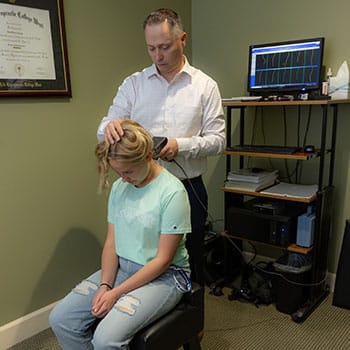
At Source Chiropractic and Wellness, Dr. John Cheney utilizes a highly precise, measurement-guided upper cervical method to help patients break the exhausting cycle of recurring dizziness. This specialized approach is a safe and comfortable option for a broad spectrum of individuals, including children and seniors.
Our process begins with an objective, detailed analysis of your symptoms and medical history. This tells us whether you have signs of an atlas subluxation. The initial assessment will also help us determine if you need additional checks like posture analysis and advanced structural imaging to calculate your specific alignment pattern down to a fraction of a millimeter. This exact data allows us to deliver a highly customized, gentle correction that mirrors your body’s unique anatomy.
The true goal of our office is not to perform repetitive, generic adjustments at every visit, but to help your spine “hold” its correct alignment for longer and longer stretches of time. It is during these prolonged periods of structural stability that your soft tissues can truly heal and your nervous system can function without interference.
By providing a stable foundation for your head and neck, we help your body clear the mixed communication signals that cause disorientation, paving the way for predictable, steady days.
Reclaim Your Steady Ground — Schedule Your Assessment at Source Chiropractic and Wellness
The most exhausting part of living with recurring vertigo isn’t just the intense sensation of spinning; it is the way it slowly shrinks your daily life. It is the anxiety that keeps you from enjoying a Saturday morning run along the mountain trails, the mental fog that derails your focus during an afternoon meeting, and the constant, nagging fear that a sudden dizzy spell will catch you completely off guard while driving home. You do not have to keep living your life at the mercy of an unpredictable balance system.
If you are ready to stop chasing temporary relief and address the core structural issue behind your recurring symptoms, Dr. John Cheney is here to help you find your footing again. Take a definitive step toward a steady, confident future by calling our Draper office today to schedule your comprehensive upper cervical assessment. Let us help you stabilize your spinal foundation so you can get back to moving through your world with total clarity and ease.
Schedule your consultation with a chiropractor for vertigo in Draper today.

Frequently Asked Questions
Why does vertigo keep coming back after I think it has completely resolved?
Vertigo frequently recurs because standard remedies often focus on temporary relief rather than the underlying structural foundation. If a subtle head-on-neck misalignment remains uncorrected, it will continue to send distorted spatial coordinates to your brain stem, triggering a flare-up the moment your system becomes overwhelmed.
Does this precise upper cervical correction involve any cracking or twisting of the neck?
No, the specialized approach utilized by Dr. John Cheney is remarkably gentle, utilizing a precise, measurement-guided contact to guide the top bone of the neck back into its proper position comfortably.
How many visits will it take before I notice a real change in my balance stability?
Every individual’s recovery timeline is unique, but many patients report a distinct sense of ease and improved clarity within their first few structural corrections. Lasting, predictable stability builds over the course of several weeks as your spine learns to hold its proper alignment consistently.
Can an old neck injury from years ago be the reason I am suddenly experiencing vertigo now?
Absolutely. A physical stressor from years ago—such as a minor car accident, a sports collision, or a slip and fall—can tear the delicate ligaments that support the top of your spine. Over time, this uncorrected structural weakness creates a chronic compensation pattern that eventually destabilizes your balance pathways.
Do I need a referral from an ENT or my primary care physician to schedule an appointment?
You do not need a formal medical referral or an outside specialist’s recommendation to begin care at Source Chiropractic and Wellness. We work directly with residents from all over Salt Lake County who are looking for a precise, structural approach to long-term health.
Why is “holding” an adjustment emphasized so much in upper cervical care?
Holding means your upper spine is successfully maintaining its balanced position without putting mechanical pressure on your nerve pathways. True neurological recovery and tissue healing only take place while your alignment remains continuously stable over time.
Can fixing a structural alignment issue in my neck help reduce daily brain fog?
Yes. When your brain stem is free from the constant mechanical strain caused by an uncorrected atlas subluxation, your central nervous system can process information cleanly without the distraction of distorted pain and balance signals, naturally clearing away brain fog.
To schedule a complimentary consultation with Dr. Cheney, call our Draper office at 385-331-7035. You can also click one of the buttons below.
For English Consultation:
Para Consulta en Español:
About the Author